


- Published: 20th Mar 26
- Tags: Google, Google Ads, Google Tag, PPC
Measurement has always been the backbone of a successful paid media strategy.
However, in an age of increasing privacy restrictions, browser limitations, and the decline of third-party cookies, advertisers must find new ways to accurately track conversions.
This is where Google Tag Gateway comes in.
Google recently introduced Google Tag Gateway for advertisers, a new way to improve measurement reliability while giving advertisers greater control over their data.
At Up Digital, we have begun to implement this feature for clients, and have already seen positive results.
This has been felt across the industry, too:
Google reports that top AI marketers have achieved a (somewhat staggering) 60% increase in revenue with Google Tag Gateway.
In this article, we will be exploring:
- What Google Tag Gateway is
- Why it matters for advertisers
- How it works
- The implementation options available
The Problem: Ineffective Measurement
Over the past few years, advertisers have faced growing challenges in accurately tracking attribution.
Key factors include:
- Browser restrictions on third-party cookies
- Ad blockers limiting tracking scripts
- Increasing privacy regulations
- Fragmented user journeys across devices
Many PPC teams rely on third-party domains, such as Google Tag Manager, to deploy measurement scripts. However, these domains are increasingly subject to blocking, throttling, and data loss, which can weaken conversion tracking and reduce the effectiveness of automated bidding strategies in Google Ads.
As a result, capturing reliable conversion data and accurately attributing performance across marketing channels has become significantly more difficult.
The Solution: Google Tag Gateway
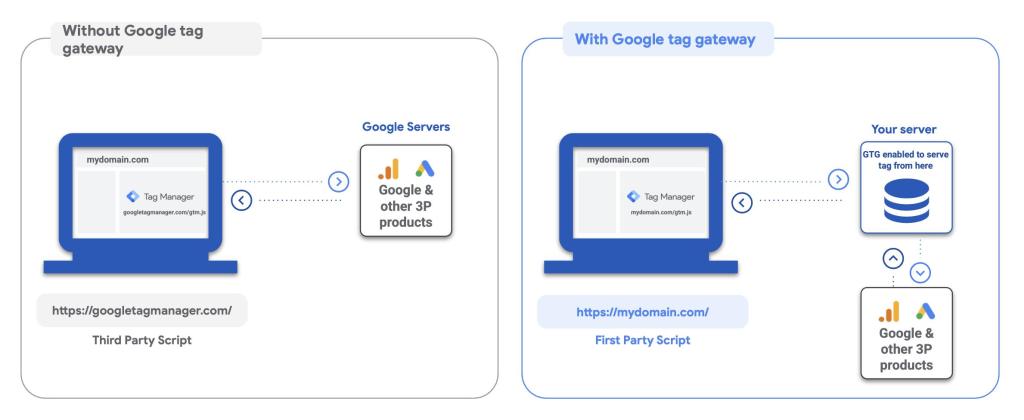
Google Tag Gateway is a solution that allows advertisers to serve Google tags from their own domain rather than a third-party’s.
In simple terms, instead of loading measurement tags from Google’s domain, they are proxied through your own website infrastructure.
This means:
- Tags appear as first-party requests
- Measurement reliability improves
- Data signals remain stronger for AI-driven optimisation
For PPC teams relying on automated bidding and conversion modelling, maintaining strong data signals is critical as these systems depend on accurate conversion data to optimise campaigns and maximise performance.
Google Tag Gateway: Why does it Matter for PPC?
For advertisers like us, specialising in paid search and paid social, accurate data feeds the machine learning models that optimise our campaigns.
When data quality drops, performance can follow.
Google Tag Gateway helps solve several common measurement problems:
- Stronger First-Party Data Signals
- Because the tags are served from your own domain, they behave more like first-party infrastructure, which browsers are less likely to block.
- More Reliable Conversion Tracking
- Improved measurement reliability ensures that conversion signals are passed back correctly to platforms like Google Ads.
- Improved Data Control
- Advertisers gain greater control over how tags are served and how measurement infrastructure is configured.
With Google Tag Gateway, advertisers are entering into a new era, where:
Performance is powered with privacy by default.
How Does it Work?
Normally, Google tags are loaded from Google’s infrastructure.
However, with Google Tag Gateway, the tags are instead served through your own domain.
This means the tag request appears to come from your website, not a third party.
Behind the scenes, the gateway routes the request to Google’s measurement infrastructure.
The result is a more resilient tagging setup that works better in modern privacy environments.
Implementation Options
There are currently two main ways to implement Google Tag Gateway: server-side tagging and CDN-based implementation.
The two setups are compared in the table below:
| Setup Option | Server-Side Tagging | CDN-Based Implementation |
| Where is it housed? | Housed in your own server. | Housed in a CDN (content delivery network) such as Cloudflare. |
| Best for: | Large advertisers Ecommerce brands Businesses with in-house development teams | Smaller advertisers & companies |
| Benefits: | Full control over measurement infrastructure Improved data governance More flexibility for advanced tracking setups | Easier to deploy Requires less infrastructure Can be implemented faster |
Google Tag Gateway: Final Thoughts
In an age of constant privacy hurdles, increased insights into measurement data have become essential for advertising agencies: because the quality of measurement data directly impacts campaign performance.
In other words, as platforms increasingly rely on AI and machine learning, data quality becomes a competitive advantage.
Google Tag Gateway represents an important step toward future-proofing measurement in a privacy-first digital ecosystem; for brands and agencies alike, the shift toward first-party measurement infrastructure is now a must.
If your current tracking setup still relies entirely on traditional client-side tagging, it may be time to review your measurement strategy.
Solutions like Google Tag Gateway can help improve measurement reliability, strengthen first-party data signals, and support more effective AI-driven campaign optimisation.
If you would like to learn more about the services we offer then please email us: hello@updigital.co.uk.
Get a free proposal here: Get a Proposal.
Call us: 0117 251 0276.
Or visit our website: www.updigital.co.uk.